When raw materials are extracted from mines, separating the desired product from unwanted waste materials can be a challenge. With magnetite, producers can use basic physics to separate the valuable from the worthless while reducing harmful and even toxic by-products, through Dense Media Separation (DMS).
DMS is used commonly in mineral processing to elevate the concentration of specific minerals and reject waste at early stages of mineral processing. It can be applied to many elements, including anthracite and bituminous coal, iron ore, lithium, lead-zinc, tin, chromite, lead, diamonds, uranium and manganese.
DMS has some important advantages, which is why it has been used globally for decades in a broad range of mineral processing situations. Compared with other gravity mineral processes, it delivers accurate separations in a highly versatile manner. Density can easily be controlled and maintained for indefinite periods, or altered quickly if needs arise. Magnetite is ideally suited for DMS processing because of its weight and the fact that a large percentage can be recovered and reused. When ultrafine magnetite is agitated in water the resulting property of the liquid has a higher density. It allows minerals that are lighter than the liquid to float and be collected separately from the sinks. This physical process concentrates the targeted mineral(s).
DMS was first pioneered in the 1950s in coal refineries that relied on varying densities of a desired product. In coal industries, the run of mine coal contains impurities such as rock, shale, and clays that makes the product unmarketable. By infusing water with magnetite, operators can alter the specific density of the water to a degree so precise that the impurities sink and cleaner coal floats.
DMS is used in the coal industry to separate impurities from the coal, thereby ‘cleaning’ the coal. Through this process, DMS reduces emissions from ‘cleaner’ coal and reduces the environmental impact of coal until transition away from fossil fuels is completed.
DMS is used in the lithium industry to beneficiate the lithium-bearing mineral spodumene from other minerals under a gravity-based separation technique. Lithium is critical to the transition to a low carbon economy globally and demand for DMS will increase as demand for lithium increases.
Due to its naturally high density, magnetite is added to concrete when weight would be an advantage, which eliminate the requirement for special equipment to manufacture high density concrete. This includes:
Magnetite is used as a component
of solid lubricants, especially popular in car brakes. It helps distribute the friction, and because it is metallic acts as a conductor to help stabilise the heat generated when braking.
Fine-milled magnetite can be used as an additive to primer and paint. Its naturally magnetic properties turn surfaces painted with these paints into magnet walls and boards.
Foundry sand is used to make the moulds when casting metal parts. Fine-milled magnetite is a common additive to these sands. Foundry sands with magnetite added produce cleaner, more defect-free castings than those without.
Flocculants separate solid matter from suspension in the water to be treated. Magnetite can be used to make both Ferric Chloride and Ferric Sulphate, two common flocculants used to treat wastewater, effluent and potable water.
Magnetite is the catalyst for the production of ammonia. Approximately 2–3% of the world’s energy budget is allocated to this chemical process. It increases the reactivity between nitrogen and hydrogen to make ammonia. It is also used to catalyse the breakdown of hydrogen peroxide, used to remove many industrial contaminants.
Magnetite can be sold as DSO because it has a high iron content and requires relatively low processing prior to delivery to buyers. Additionally, the proximity of the Broula DMS Mine by road to an onshore iron ore smelter makes the purchase of DSO attractive to the potential buyer.
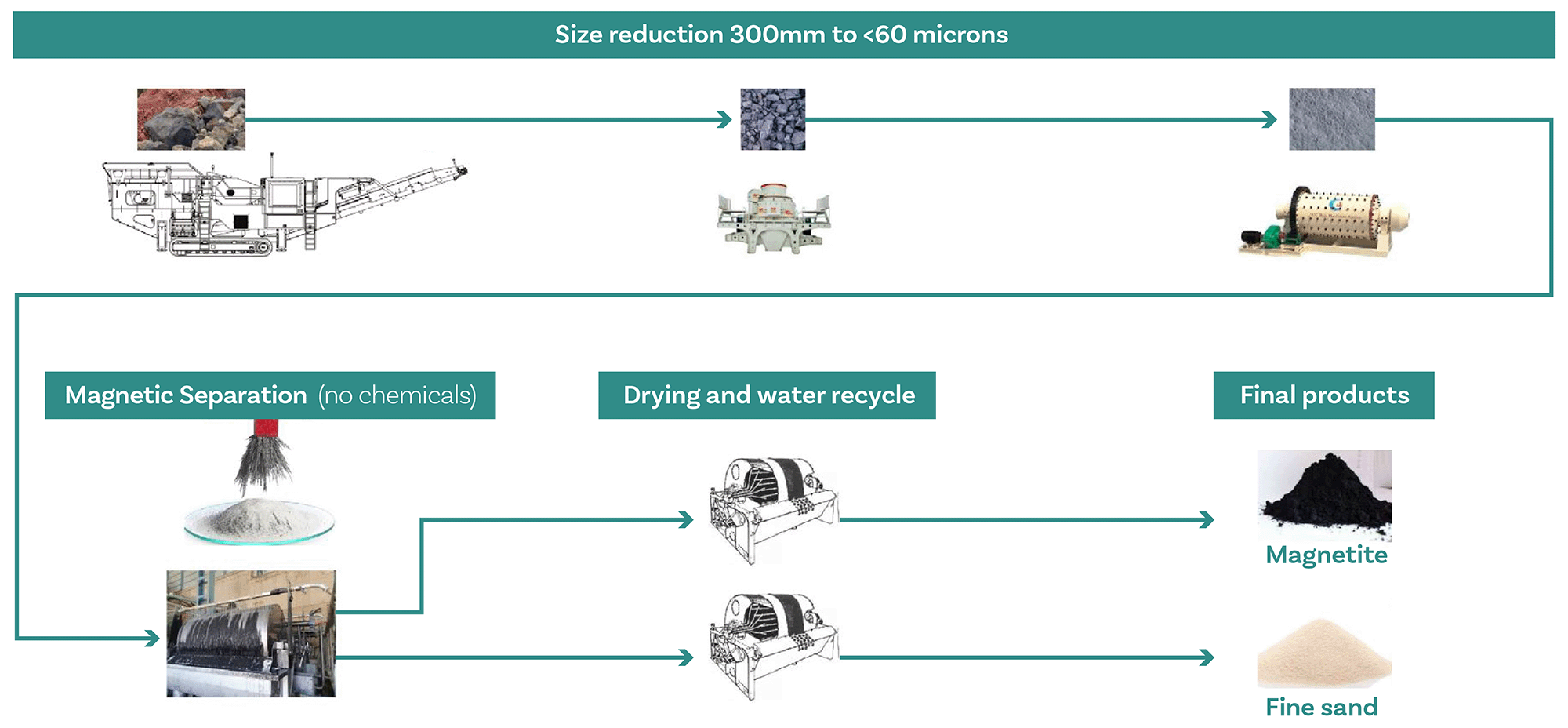
Manufacturing DMS is a two step process: